




The NEDAW 2026 Toolkit is designed to help individuals and organizations raise awareness, promote conversations, and support recovery during the observance.
How to Use the Toolkit
- Explore the resources. Look through the materials for the best tools to serve your audience and community.
- Download and share the resources. Access the 2026 NEDAW resources and share them widely. These resources are free to use and copyright free.
- Promote the resources on social media. Use the ready-made graphics and posts on your social media channels. Don't forget to use the hashtag #NEDAW to reach a broader audience.
- Tag us! Don't forget to tag the Office on Women's Health (OWH) on social media so we can cross promote your messaging.
- Facebook: @HHSOWH
- X: @womenshealth
- LinkedIn: @HHS Office on Women's Health
Sample Social Media Messages
OWH has developed a series of messages for use by federal partners and non-federal collaborators to use across their social media channels to uplift the messaging of NEDAW. Explore the messages and tag @HHSOWH on Facebook, @womenshealth on X, and @HHS Office on Women's Health on LinkedIn.
Shareable Graphics
To save the graphics below, click “View Image” under the graphics to access the full-size version, right click or hold on the image, then save to your device. Feel free to use the sample social media messages above to accompany the graphics.
 View image
 View image
 View image
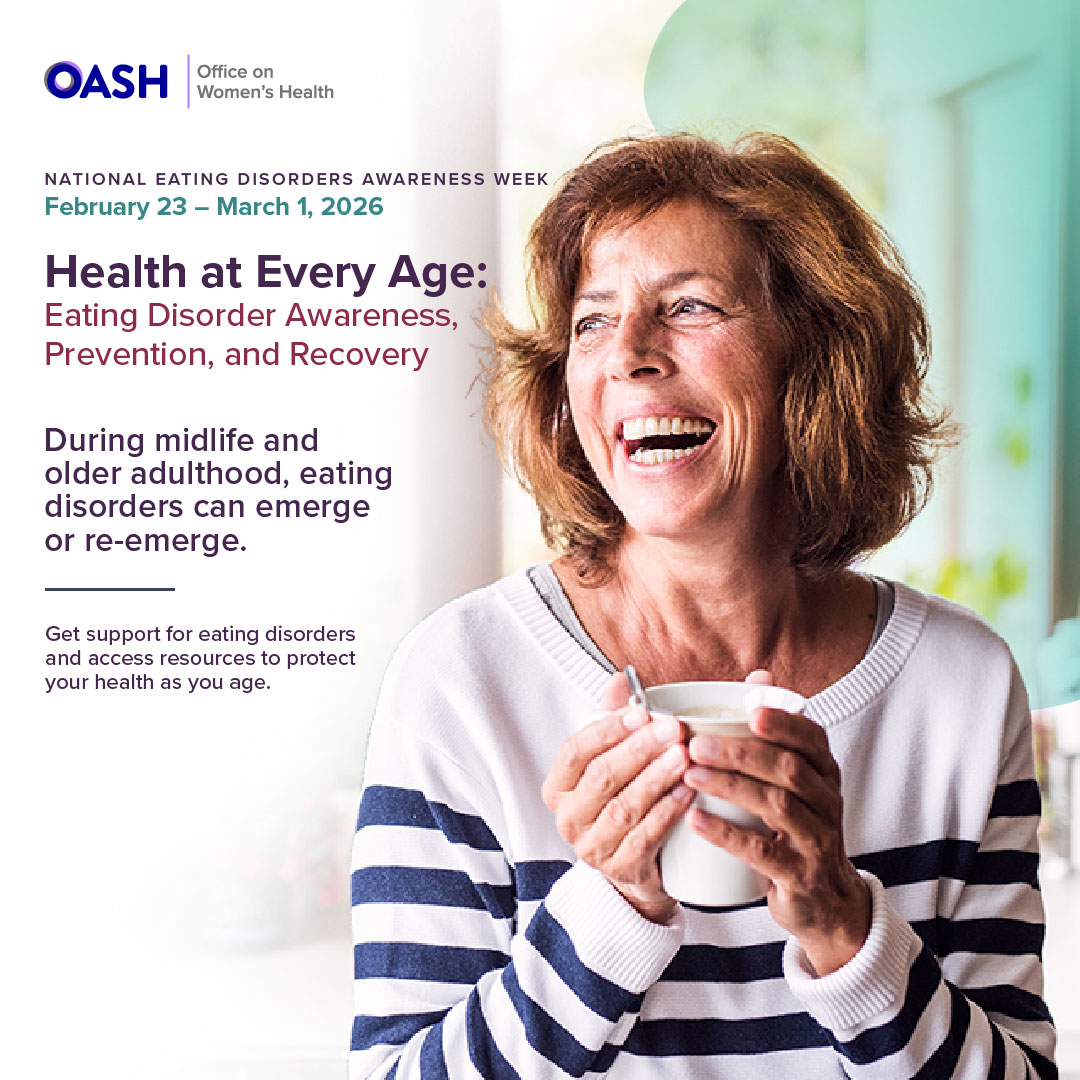 View image
Fact Sheet
OWH has developed an educational fact sheet which provides an overview of the transition through menopause, describes eating disorders and disordered eating, details the link between menopause and eating disorders, and provides resources for eating disorder support and treatment. Access the fact sheet using the link below.
 Fact Sheet - NEDAW 2026 Factsheet
Resources to Learn More
Explore and share the resources below to learn more about eating disorders and access services from partners and collaborators.
Federal Resources
- Behavioral Health Treatment Services Locator - Substance Abuse and Mental Health Services Administration (SAMHSA)
- Disordered Eating - U.S. Department of Veterans Affairs (VA)
- Eating Disorders - National Institute of Mental Health (NIMH)
- Eating Disorders - Office on Women's Health (OWH)
- Eating Disorders - Substance Abuse and Mental Health Services Administration (SAMHSA)
- Eating Disorders: What You Need to Know - National Institute of Mental Health (NIMH)
- Menopause - Office on Women's Health (OWH)
- Mental Health - U.S. Department of Veterans Affairs (VA)
Additional Resources
- American Psychiatric Association
- Eating Disorders Coalition for Research, Policy & Action
- Eating Recovery Center
- MEDA (Multi-Service Eating Disorders Association)
- National Alliance on Mental Illness
- National Center of Excellence for Eating Disorders - The University of North Carolina at Chapel Hill
- National Eating Disorders Association
- Project HEAL
Get Help Now
Taking the first step to get help for an eating disorder can be difficult and takes courage. The sooner you reach out, the sooner you can find support and treatment. Treatment and recovery will look and feel different for everyone. Your journey is your own and may involve many different people, such as doctors, dietitians, mental health professionals, dentists, physical therapists, and, of course, those in your support network. Explore the options below to find what works best for you.
- Emergency medical services — Call 911.
- 988 Suicide & Crisis Lifeline: Call or text 988 for free immediate help. You can also get help by using the chat feature at https://988lifeline.org.
- Veterans Crisis Line: Call 988 and then press 1, or text 838255.
- ANAD Helpline: Call 888-375-7767 for free help Monday-Friday, 10 a.m.-10 p.m. ET.
- National Alliance for Eating Disorders Helpline: Call 866-662-1235 for help Monday-Friday, 9 a.m.-7 p.m. ET.
- Diabulimia Helpline: Call 425-985-3635 for free assistance 24/7 for people with diabulimia, an eating disorder in which people with Type 1 diabetes limit insulin to lose weight.
- National Maternal Mental Health Hotline: Call or text 833-TLC-MAMA (833-852-6262) for free assistance and referral support in multiple languages 24/7 from trained counselors.
- Substance Abuse and Mental Health Services Administration (SAMHSA) National Helpline: Call 800-622-4357 or text 435748 (HELP4U) for free, confidential treatment referral and information service 24/7 for individuals and families facing mental and/or substance use disorders.